
Deed Types in Jennings County
A deed is more than a receipt. Jennings County deed records live alongside mortgages, releases, liens, plats, and easements. All of it sits in one Recorder's system. That shared arrangement helps. Ownership and the burdens tied to land often must be read side by side. The recorded document itself names the parties and spells out execution terms. It also carries the legal description and supplies the recording reference. A result row alone tells you less than the deed.
| Deed Type | What It Does | Common Use |
|---|---|---|
| Warranty deed | Conveys the grantor's interest with title promises stated in the instrument | An ordinary sale |
| Quitclaim deed | Conveys whatever interest the grantor holds without the same promises | Family transfers or title cleanup |
| Executor or trustee deed | Conveys property through an estate or trust representative | Estate and trust administration |
| Sheriff's deed | Records a conveyance tied to a judicial sale | Foreclosure proceedings |
| Tax deed | Records a conveyance following the statutory tax-sale process | Delinquent-tax property |
Not every instrument conveys land. A mortgage or lien can burden real estate without moving ownership at all. Releases, assignments, and satisfactions also matter, since they show how an earlier claim ended. For a purchase, an estate, or a boundary review, pull the deed first. Then search the same parties in the deed records. Also match the legal description there. Look for any connected instruments.
Search Jennings Deeds in Doxpop
The Doxpop recorded-document search serves as the county's online retrieval route. Jennings County index data and scanned images begin in November 1991. The county describes its local system as current. It is also back-indexed about 30 years for deeds, mortgages, and mortgage releases. Search options include person, parcel or legal description, and document. Do not expect a street address on every recorded instrument. Many deeds simply do not carry one.
| Search field | Use | Format clue |
|---|---|---|
| Person or party | Find a grantor or grantee | Try initials and entity-name variants |
| Date range | Narrow a transfer period | Start wide if the recording date is uncertain |
| Document type | Limit the kind of instrument | Confirm current choices in the live screen |
| Document number | Pull a known filing | Copy the full reference exactly |
| Platted legal | Search subdivision, addition, lot, or block | Use the recorded spelling |
| Unplatted legal | Search section, township, range, or quarter | Useful for rural land |
Doxpop also offers OCR full-text searching plus a filter for narrowing results. OCR means software-read text. It can miss old, faint, or uneven images. A failed text query does not prove the deed is missing. Viewing the index may be free under the available account level. Saving document images can carry a per-page charge.
Note: Treat November 1991 as the online coverage line, not the start of Jennings County deed records.
Jennings County Index and Image
An index result is only a pointer. A deed image is the recorded document itself. The result may show party names, a recording date, the document type, an instrument number, and a short legal description. The image holds the rest: reservations, exceptions, signatures, acknowledgments, and a fuller land description. The Jennings County Doxpop search page is the place to find the current portal. Keep in mind that online retrieval stays separate from a certified Recorder copy.
That page leads straight into the indexed record search. Once a result appears, preserve its document number and legal description. The Recorder can then locate the same filing even if the image is unavailable.
Follow the Jennings Grantor-Grantee Chain
The grantor conveys the interest. The grantee receives it. A chain of title is the linked sequence of those conveyances for one piece of land. Jennings County deed records can be followed backward, with each deed naming the party to search next. Keep the legal description in view throughout. Names change, people own several parcels, and entities may appear with punctuation or suffix variations.
- Use the assessor card or latest known deed to identify the present grantee and exact parcel description.
- Find that person's or entity's acquisition deed, then record its grantor, date, instrument number, and legal description.
- Search the prior grantor as an earlier grantee. Compare the land description before accepting the match.
- Repeat until the online trail reaches its cutoff, then move the last book/page or party reference into older indexes.
- Grantor
- The party that transfers the interest.
- Grantee
- The party that receives the interest.
- Chain of title
- The ordered sequence of recorded conveyances tied to the same land.
- Book and page
- A reference to a bound or imaged record volume and page.
- Instrument number
- A unique filing reference assigned to a recorded document.
Older Jennings Deed Books
Jennings County was created in 1817. The Indiana State Library microfilm finding aid lists deed records from 1817 through 1887 and general deed indexes from 1818 through 1887. The guide names exact volume groups and film call numbers. One general index group, for instance, covers Volumes 1 through 3 for 1818 to 1857. Early deed record film includes Volumes A through C for 1818 to 1834.
Those films are not a modern name-search site. Start from the last reliable modern party, book and page, or legal description. Then ask the Jennings County Recorder or library staff how to reach the right volume and index. Platted land is usually described by addition or subdivision, lot, and block. Rural land may use section, township, range, and quarter. Exact spelling matters at every step.
The Jennings County Public Library also holds current plat maps, local histories, copies of wills and probate files, and partially indexed newspapers that begin with the Vernon Banner in 1859. Newspaper legal notices can hint at a sheriff's sale, estate, or partition. Only the deed book confirms the transfer.
Four Jennings Record Eras
The county's record trail does not cross one clean digital boundary. A useful working timeline separates original land entries and early books from nineteenth-century indexes, then twentieth-century paper or microfilm, and finally modern portal records.
- 1817 onward: original land entries and the earliest Jennings County deed books establish the first county-era trail.
- 1818-1887: filmed deed indexes and volumes provide a structured path through early ownership.
- Twentieth century: Recorder books, office indexes, and later microfilm bridge the historic and online periods.
- November 1991 onward: Doxpop provides Jennings index data and scanned images, while county systems supply parcel and transfer references.
A modern parcel card may display a very old transfer line. It may not provide the old instrument image. Conversely, an index can point to an image. That image's text search may fail. The durable handoff is a party name plus the exact land description and recording reference. Those three details travel across every era of Jennings County deed records.
Note: A documented 1859 Vernon fire did not establish that county land books were destroyed. No records-loss claim should be inferred.
Jennings Property Watch Alerts
Doxpop Property Watch is a free service. It sends an alert whenever a new document is recorded under a chosen name in an Indiana county. Setting one up takes a minute. Pick Indiana. Pick Jennings County, and type the exact personal or business name that appears on your recorded instruments. Doxpop advises registering one name at a time. Stacking variants in a single registration tends to pull in matches you do not want.
Treat each alert as an early heads-up rather than evidence of fraud. Common names generate noise. When a notice about a deed or other filing looks unfamiliar, check the indexed party, document type, legal description, and instrument number against your own deed records before drawing conclusions. The Recorder can settle anything still unclear at its official number.
The Property Watch signup page displays the county-and-name setup a Jennings County owner will complete.
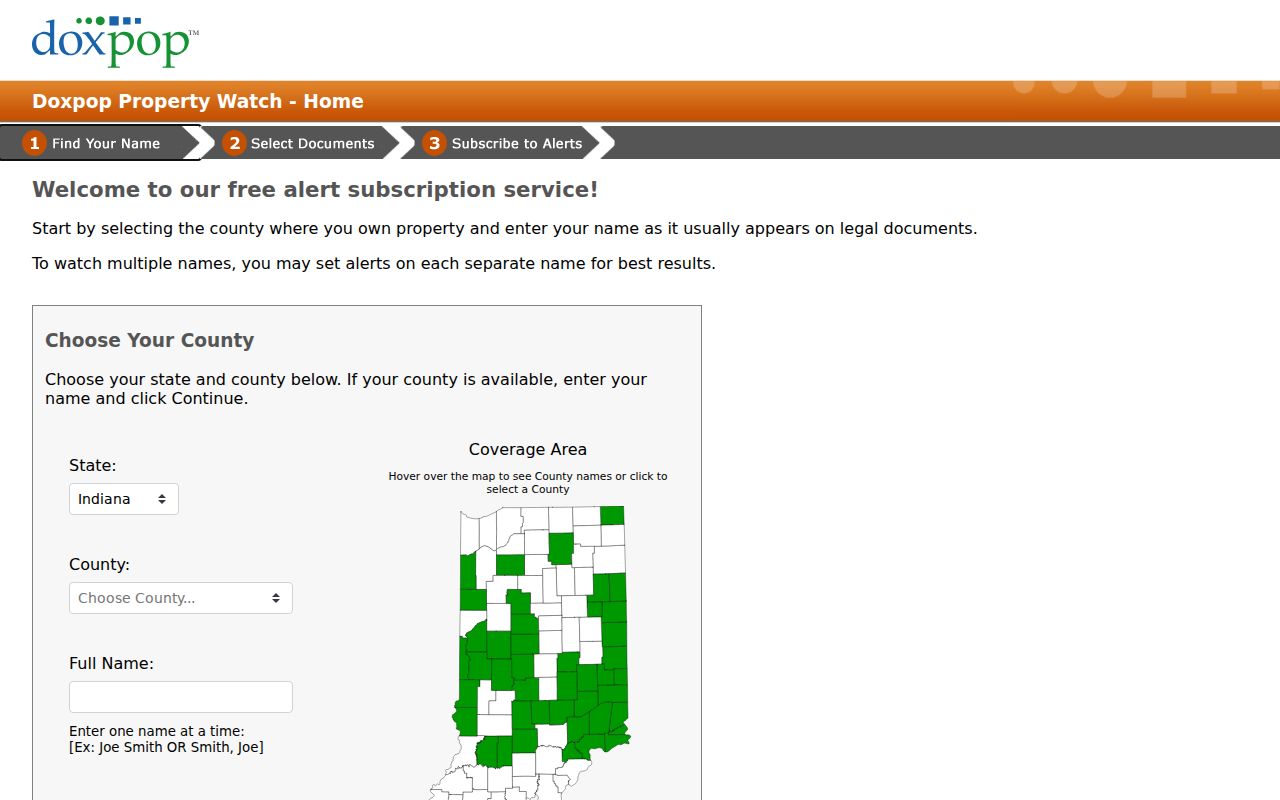
The same screen shows why name variants matter. Joint owners, trusts, and business entities may each need their own registration, using the spellings found in the recorded deed record itself, so every Jennings County filing surfaces under watch.
Reach the Jennings County Recorder
The Jennings County Recorder works out of the Government Annex at 200 East Brown Street in Vernon, Indiana 47282. The listed phone is (812) 352-3053, and the counter is open Monday through Friday, 8:00 a.m. to 4:00 p.m. When an older deed, a confusing index row, a certified copy, or a current fee resists resolution online, a visit is the dependable fallback. So is a phone call.
Doxpop, the counter, and the mail each fit a different job. Before mailing any deed request, confirm the document reference, the current copy or certification charge, accepted payment, and return postage, and ask whether the volume you need is stored on site. The county's own page posts its current fee schedule, which beats third-party summaries every time.
Jennings County Recorder
200 East Brown Street
Vernon, IN 47282
(812) 352-3053
Monday-Friday, 8:00-4:00
Indiana's Access to Public Records Act gives every requester a path to these files. A focused request should identify the deed by date range, parcel, party, or instrument number and say how you want delivery. Inspection is generally free, though copies, certification, mailing, and nonstandard reproduction can carry permitted fees.
Order a Jennings County Deed
Start in the Doxpop index and write down the instrument number or book and page. A viewable image may be all you need. Want a plain office copy or a certified deed instead? Contact the Recorder with the parties, recording date, document reference, and legal description. Certification is just the Recorder's attestation to the office copy. It is not a title opinion.
When the index stops short of the transfer you want, the Recorder's counter and the State Library finding aid cover the gap. Phone ahead before mailing a request. The Jennings County former-owner trail walks each transfer backward. It suits anyone tracing a deeper chain of owners of record.
Recorded, not guaranteed. Jennings County deed records show what entered the public record. They do not establish that every interest was recorded or provide a legal title opinion.
Note: Match every copy against the parcel's legal description, because a shared name alone can point to the wrong tract.